Technical Passport for Agricultural & Seafood Exports: Exporting seafood, poultry, and tropical produce into US, Japanese, and EU supermarkets mandates industrial cold chain infrastructure certified under Codex HACCP Hazard Analysis and Critical Control Points and the US FDA Food Safety Modernization Act (FSMA). A minor design defect such as standing water traps or uncalibrated logging software risks whole-cargo port rejection.
4. Sanitary Drainage & Odor/Pest Prevention Engineering
Among the primary non-compliances causing food plants to fail HACCP/FDA audits is sub-standard floor drainage generating microbiological breeding grounds:
- SUS304 Floor Drains with Deep Seal Water Traps: All evaporator defrost condensate lines and floor wash drains feature stainless steel bell traps with >= 50mm deep water seals, completely barring sewer odors and sewer gases from back-drafting into clean refrigerated rooms.
- Dual-Stage Removable Stainless Insect Screens: Perforated coarse debris baskets and secondary micro-mesh insect barriers in stainless steel, effortlessly removable for daily CIP sanitation without tools.
- Internal Trace Heating for Sub-Zero Drain Manifolds: Inserting continuous self-regulating defrost heater cables inside sub-zero drain piping, ensuring meltwater drains cleanly out of the envelope without freezing, pipe blockage, or hazardous ice accumulation on floors.
5. Pre-Audit Self-Assessment Checklist for FDA & HACCP Inspections
| Audit Category | FDA / HACCP Regulatory Requirement | Tan Long Engineered Solution | Compliance Level |
|---|---|---|---|
| Wall-to-Floor & Ceiling Junction Coving | Zero 90° sharp corners trapping dirt & bacteria | Anodized R = 50mm coved aluminum sanitary trim with antimicrobial coating | 100% Compliant |
| Cold Room Flooring Material | Level, non-slip, crack-free, forklift heavy-load resistant | Self-leveling antibacterial Epoxy or densified polished concrete with acid-resistant hardener | 100% Compliant |
| Cold Storage Chamber Lighting | Illuminance >= 220 lux, shatterproof protective luminaire shields | IP65 low-temperature LED luminaires rated to -30°C with shatterproof Polycarbonate diffusers | 100% Compliant |
| Temperature Sensor Calibration | Periodically calibrated and certified by accredited metrology authorities | PT100 RTD sensors with rapid calibration validation ports, Quatest 3 certified | 100% Compliant |
| Loading & Unloading Anteroom Staging Area | Maintains controlled climate, preventing refrigeration loss to exterior | Ante-room staging vestibule (0°C to +5°C) integrated with high-speed PVC doors | 100% Compliant |
1. Core Principles of HACCP & FDA Cold Storage Design
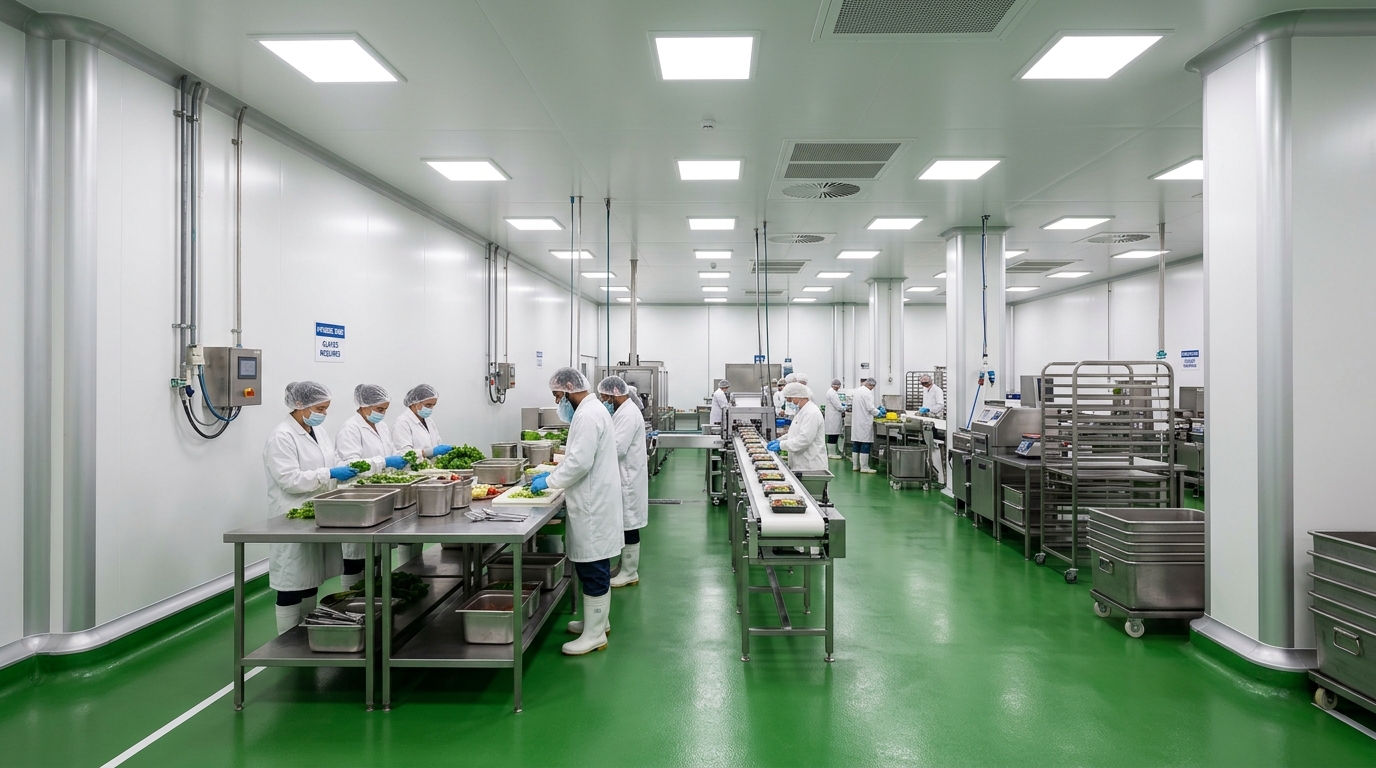
HACCP compliance is not a paper exercise; it must be materialized directly in architectural blueprints and mechanical/electrical (M&E) engineering:
- One-Way Material Flow Architecture: Product flows (raw material intake → preparation → blast freezing → packaging → cold storage → dispatch) must advance along a strictly unidirectional path without cross-traffic to eliminate cross-contamination risks.
- Pressurized Climate-Controlled Anteroom Vestibules: Isolating outdoor ambient air from sub-zero freezers. The anteroom buffer must maintain a slight positive air pressure with filtered air to exclude dust and pests.
- 100% Elimination of Biofilm Microbial Traps (Sanitary Design): All wall-to-ceiling and wall-to-floor junctions must incorporate coved aluminum or stainless steel sanitary profiles R50 (50mm curvature radius), preventing dirt accumulation and enabling pressurized foam spray cleaning.
2. Material Specifications for Insulated Enclosures & Sanitary Doors
- Insulated Wall & Ceiling Panels: Recommended specification: 150mm thick PU panels or fire-rated PIR panels. Facings clad in hairline SUS304 stainless steel or Clean Colorbond antimicrobial steel certified zero toxic migration into food products.
- Airtight Thermal Insulated Doors: Installation of T-Light sliding cold storage doors equipped with perimeter defrost heater gaskets to prevent mold, paired with high-speed PVC doors at container dock loading bays.
- Cold Storage Floor Slabs: Heavy-load reinforced concrete slab finished with self-leveling antibacterial Epoxy or abrasion-resistant densified polished concrete, with a 1% – 1.5% drainage pitch towards drain gullies fitted with odor traps and stainless rodent screens.
3. Automated Temperature Telemetry Under FDA 21 CFR Part 11

The US FDA mandates that cold storage temperature logs must be recorded automatically via electronic data acquisition systems:
- Continuous 24/7 logging interval of 5 to 10 minutes per data point.
- Software architectures must provide an immutable Audit Trail: No user (including administrators) can alter or delete logged historical data. Tan Long deploys the IoT SCADA Temperature Telemetry System fulfills these stringent regulatory mandates.
Technical FAQs: HACCP & FDA Cold Storage Compliance
1. Can existing non-compliant cold rooms be retrofitted to meet HACCP and FDA criteria?
Fully achievable. Tan Long specializes in facility audits, retrofitting R50 sanitary coving, replacing outdated doors with T-Light airtight sliding doors, applying antibacterial self-leveling Epoxy floors, and installing automated thermal logging sensors to achieve international export compliance within 15 to 20 days.