The era of industrial cold storage 4.0: Electricity costs account for 60% - 70% of the total monthly operating costs of a cold storage. Manual operation based on the worker's experience often leads to wasteful running of the compressor or forgetting to defrost the refrigeration unit. Tan Long IoT SCADA System provides an automation brain that helps the system self-optimize in real time.
2. Tan Long's 3-Tier Industrial Automation & SCADA Architecture
The cold storage automation system developed by Tan Long is built on the industrial standard structure IEC 61131-3, ensuring 99.99% security and continuous operation even when the Internet connection is lost:
- Field Level: PT100 Class A temperature sensor network with ± 0.1°C accuracy, 4-20mA compression/suction pressure sensor, explosion-proof NH3/Freon gas leak sensor and Modbus RTU Schneider/Socomec multi-function power meter.
- Local Control Level (Control Level): Industrial Siemens S7-1200 / S7-1500 PLC programmable controller combines a 10-15 inch HMI touch screen in the central control room, handling PID control algorithms, compressor rotation and intelligent defrosting.
- Cloud SCADA Level: The Industrial IoT Gateway sets TLS 1.3 data encryption and pushes data to a separate cloud server, allowing directors and engineers to monitor on Web Dashboard and iOS/Android Smartphone applications from anywhere.
3. Comparative Analysis: Conventional Cold Stores vs. IoT SCADA Facilities
| Operating Criteria | Old Mechanical Relay Electrical Cabinet System | Tan Long SCADA & IoT System |
|---|---|---|
| Temperature monitoring method | Manually taking notes every 2-4 hours, prone to errors | Automatic data recording every 10 seconds, 5-year cloud storage without intervention |
| Incident warning mechanism | Sirens on site, at night or on holidays are easily overlooked | Automatically call, SMS and multi-channel App notifications in 5 seconds |
| Condensing pressure control | Depending on the season, the compressor always runs at high pressure, causing power loss | Floating Head Pressure algorithm automatically lowers compression pressure when it's cool, saving 12 - 18% electricity |
| Cooler defrost cycle | Set a fixed timer regardless of whether the condenser has snow or not | Defrost on Demand, cutting the number of defrost times by 40%. |
| Quality approval report | It takes many days to extract data, making it difficult to meet inspection standards | Export PDF/Excel reports meeting HACCP, ISO 22000, FDA 21 CFR Part 11 standards with 1 click |
4. AI-Driven Predictive Maintenance for Refrigeration Compressors
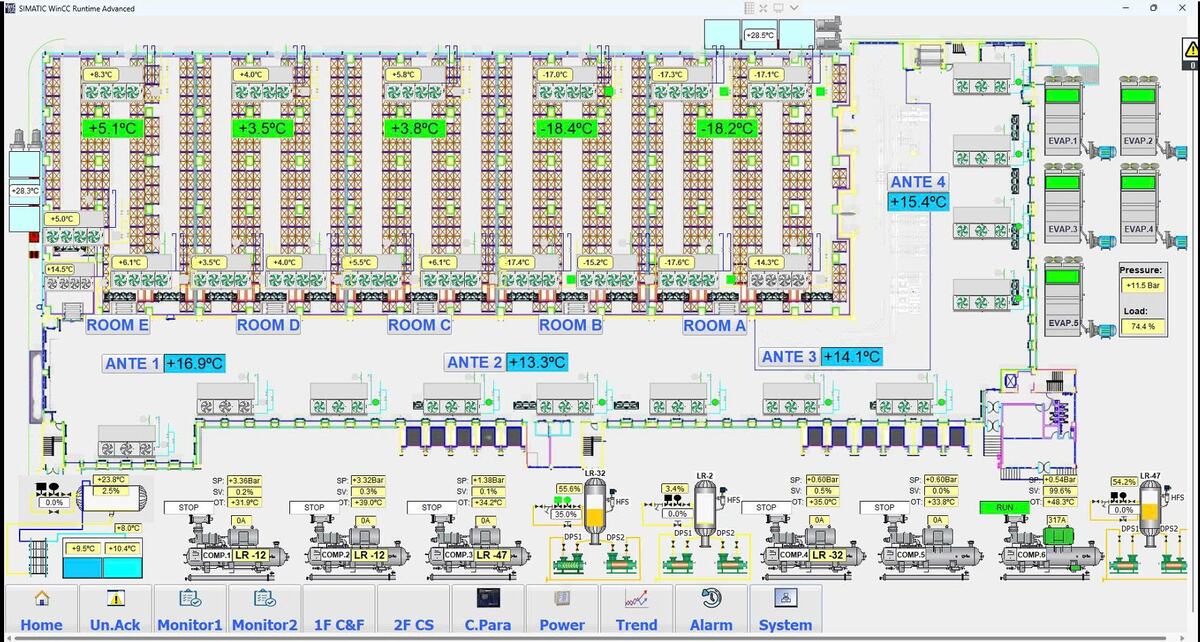
Tan Long IoT system integrates time-series analysis algorithm to warn of mechanical damage before serious incidents occur:
- Monitor compression ratio & volumetric efficiency: When the difference in compression/suction pressure fluctuates beyond the allowable threshold, the system warns that the one-way valve is open or the piston ring is worn.
- Analysis of compressor discharge head temperature: Detecting the risk of liquid floodback ensures absolute safety for Bitzer and Mycom screw compressors.
- Monitor motor current: Early identification of phase loss, phase shift or dry bearing grease before burning motor coils.
1. Core Functional Modules in Smart Cold Storage SCADA
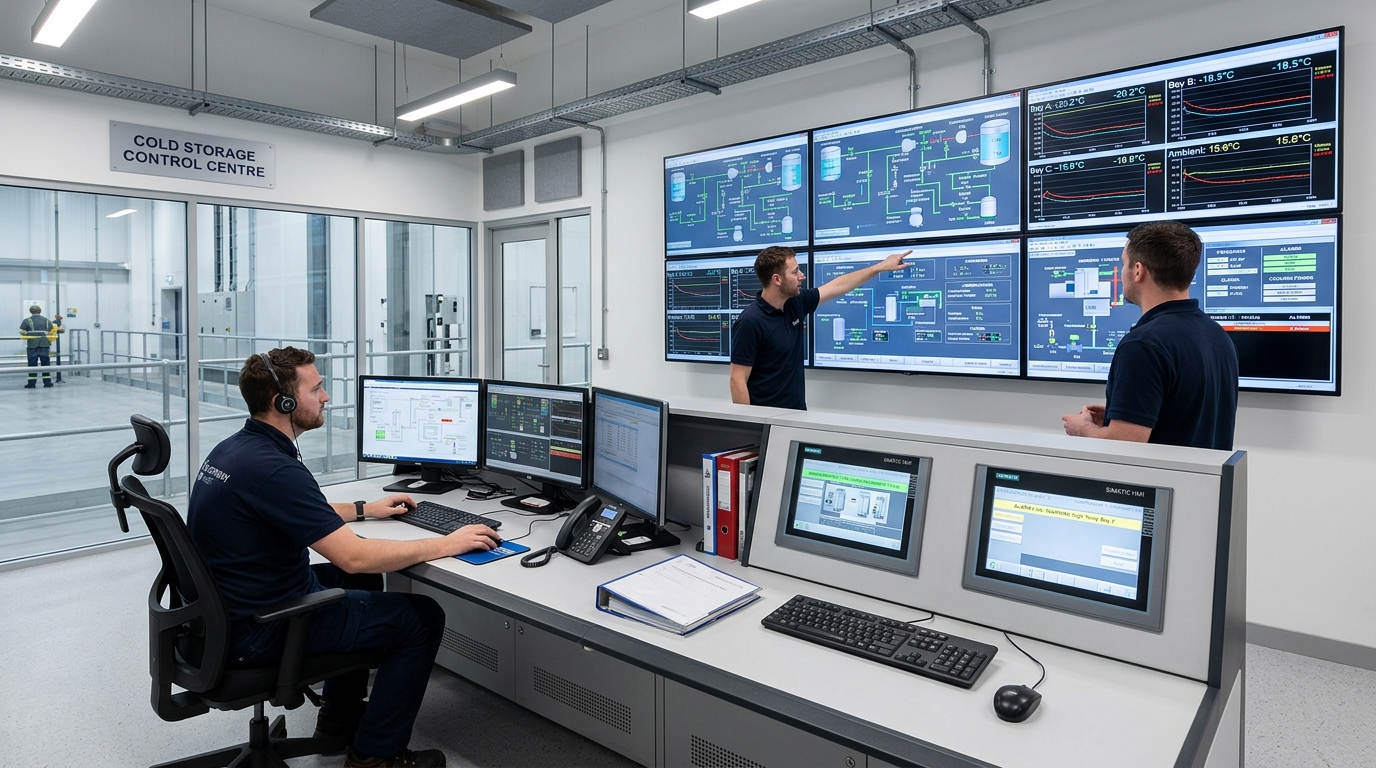
- Variable frequency control (VFD) of the compressor according to suction pressure: The variable pressure sensor continuously sends signals to the central PLC to speed up the screw compressor motor, completely eliminating the peak starting current and maintaining the compressor operating at the highest COP performance point.
- Defrost the refrigeration unit according to actual needs (Demand Defrost): Instead of setting a rigid defrost timer every 4 hours, which reduces temperature pressure and wastes electricity, SCADA measures the wind pressure difference (ΔP) across the evaporator and the temperature difference. Only when the aluminum blade surface is truly frost-covered blocking the airflow will the system activate the defrost cycle with hot water or gas.
- Running cold storage during off-peak hours (Night-time Thermal Storage): Automatically lowers the warehouse temperature at night (when the electricity price is only 1/3 of daytime and the cool ambient temperature helps evaporative condenser cool down better). During the day during peak hours, SCADA automatically reduces compressor load, taking advantage of the heat accumulated in goods to save hundreds of millions in electricity bills.
Technical FAQs: Cold Storage IoT & SCADA Systems
1. Can the IoT SCADA system be installed for old cold storage compressor clusters?
Okay. Engineer Tan Long can integrate the pressure sensor, Modbus multi-function meter and PLC controller into the existing electrical cabinet of the cold storage without having to replace the compressor.